
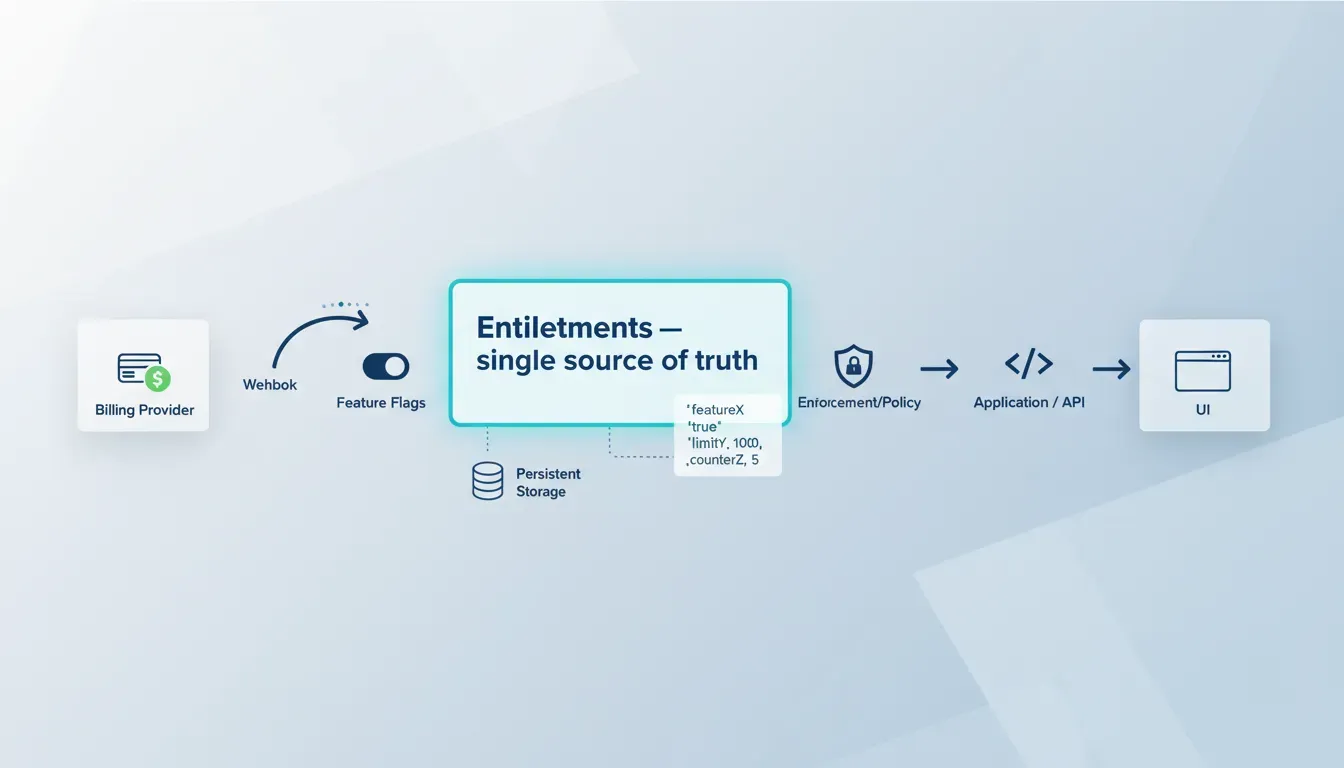
Once SaaS teams accept that billing is not access control and pricing is not enforcement, a practical question immediately follows:
Where should entitlements actually live in a SaaS system?
This is where many teams stall.
They agree entitlements matter, but aren’t sure whether they belong:
- in the billing provider
- in feature flags
- in the database
- inside application code
- or spread across all of the above
This article gives a clear, opinionated answer and shows how mature SaaS systems structure entitlement logic so it scales with pricing, customers, and product complexity.
The core principle: entitlements belong to the product domain
Entitlements should live inside your product, not inside your billing provider and not hidden in conditional logic.
They are part of your business domain, just like users, accounts, and permissions.
That means:
- your application owns entitlement state
- your database persists entitlement decisions
- your product logic enforces them consistently
External systems — including billing tools — should only inform this state.
The common (but broken) alternatives
Before outlining the right approach, it’s useful to see why the usual alternatives fail.
Option 1: Entitlements inside Stripe
Some teams attempt to infer access directly from:
- subscription status
- price IDs
- metadata fields
This creates:
- tight coupling to billing internals
- race conditions via webhooks
- brittle pricing changes
Stripe is an event source — not an access authority.
Option 2: Entitlements as feature flags
Feature flags are excellent for:
- rollouts
- experimentation
- kill switches
They are not designed for:
- quotas
- limits
- long-lived access state
- customer-specific exceptions
Using feature flags as entitlements results in opaque, unmaintainable logic.
Option 3: Entitlements as hard-coded plan checks
Early-stage code often looks like:
if (plan === "pro") enableFeature()This breaks immediately when:
- plans change
- customers are grandfathered
- sales makes exceptions
Hard-coded plans turn pricing into a permanent constraint on engineering.
The correct model: a dedicated entitlement layer
Mature SaaS systems implement entitlements as a first-class layer.
Conceptually:
- Billing systems emit events
- Pricing defines mappings
- Entitlements store decisions
- The application enforces rules
Entitlements become the single source of truth for access.
What an entitlement layer actually contains
A real entitlement system is not a single boolean.
It typically stores:
- feature access flags
- numeric limits (seats, usage, quotas)
- consumption counters
- expiration timestamps
- override reasons and sources
For example:
{
  "ai_export": { "enabled": true },
  "projects": { "limit": 25, "used": 18 },
  "api_calls": { "limit": 100000, "reset_at": "2025-02-01" }
}
This state is:
- explicit
- inspectable
- auditable
- enforceable at runtime
Where this lives technically
In practice, entitlements usually live:
- in your primary application database
- keyed by account or organization
- versioned or timestamped
They are queried:
- on API requests
- during UI rendering
- at usage checkpoints
They are not recalculated on the fly from billing state.
How billing integrates without owning access
Billing systems like Stripe should:
- trigger entitlement updates
- never be queried synchronously for access
A typical flow:
- Billing event occurs (upgrade, cancel, payment failure)
- Webhook arrives
- Entitlement update logic runs
- New entitlement state is persisted
From that point on, the application relies only on stored entitlements.
This removes:
- webhook timing risk
- external dependency latency
- access flapping
Why pricing becomes safer with this approach
When pricing changes:
- entitlement mappings change
- historical entitlements remain valid
- legacy customers stay correct
Because pricing definitions are decoupled from enforcement, experimentation becomes low-risk instead of terrifying.
Organizational benefits
Clear entitlement ownership simplifies collaboration:
- Product defines capabilities
- Growth experiments on pricing
- Finance owns billing
- Engineering enforces access
Each team moves independently without stepping on the others.
When teams usually realize they need this
Most companies reach this conclusion when:
- enterprise deals appear
- support load spikes
- pricing changes slow releases
- billing bugs reach customers
Unfortunately, that’s also when refactors are most painful.
Building an entitlement layer early pays off disproportionately.
Final takeaway
Entitlements are part of your product, not your billing stack.
They should:
- live in your application domain
- be stored explicitly
- be enforced consistently
Billing tools inform entitlements. Pricing defines them.
Your product enforces them.
Get this boundary right, and your SaaS architecture can scale without fear.