
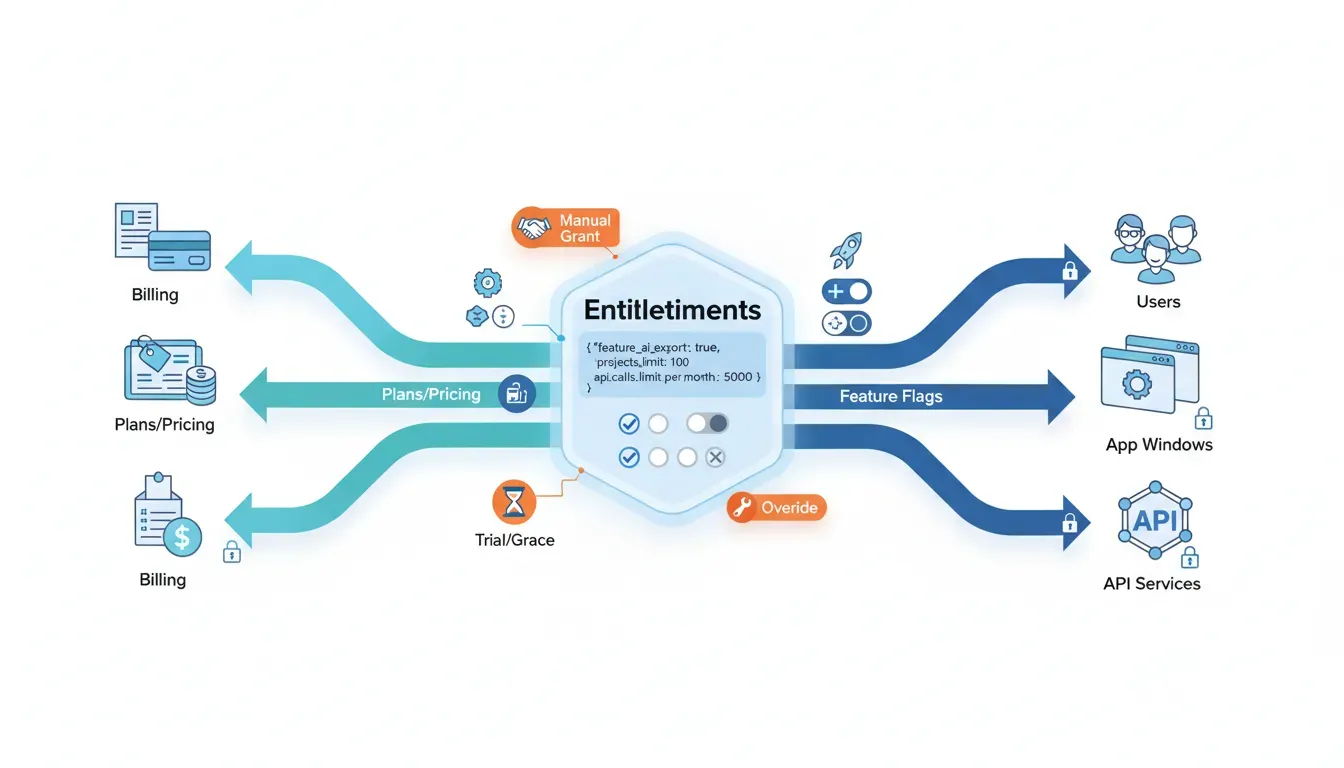
Now that we’ve established why billing, pricing, and access control must be treated separately, the next question naturally follows:
What exactly are SaaS entitlements?
This is one of those concepts that almost every mature SaaS product implements — but very few clearly define. As a result, entitlement logic often grows organically, scattered across database fields, feature flags, and conditionals.
In this article, we’ll make entitlements concrete:
- what entitlements are (and are not)
- how they differ from plans, roles, and feature flags
- what real entitlements look like in production systems
- and why centralizing them changes how your product scales
A simple definition
A SaaS entitlement is an explicit, enforceable statement of what an account is allowed to do right now.
An entitlement answers questions like:
- Can this account access Feature X?
- What is the maximum number of seats, projects, or API calls?
- Is this capability active, paused, expired, or overridden?
- Does this customer qualify for an exception?
Unlike pricing or billing, entitlements are not descriptive.
They are evaluated at runtime and must return a deterministic answer.
Entitlements vs plans
Plans are a source of entitlements — but they are not entitlements themselves.
For example:
- “Pro plan” is a pricing concept
- “Can create up to 10 projects” is an entitlement
When teams treat plans as entitlements, they hard‑code logic like:
if (plan === "pro") {
  allowProjects = 10
}
This works until:
- you change plan limits
- a customer is grandfathered
- sales negotiates a custom deal
Entitlements make these rules explicit per account, independent of plan naming.
Entitlements vs feature flags
Feature flags control deployment and experimentation.
Entitlements control customer access.
While both are booleans at the surface, they solve different problems:
| Feature Flags | Entitlements |
|---|---|
| Who sees new code | Who can use a feature |
| Rollouts & A/B tests | Pricing & access rules |
| Usually temporary | Long‑lived |
| Developer‑centric | Business‑critical |
Using feature flags to enforce pricing works — briefly — until flags become permanent and contradictory.
What entitlements look like in real systems
Mature SaaS products represent entitlements as structured state, not conditionals.
Common entitlement dimensions include:
- boolean access (can/cannot)
- numeric limits (counts, quotas)
- usage‑based allowances
- expiration windows
- override flags
A conceptual example:
{
  "feature_ai_export": {
    "enabled": true
  },
  "projects": {
    "limit": 10,
    "used": 7
  },
  "api_calls": {
    "limit_per_month": 100000,
    "reset_at": "2025-02-01"
  }
}
The application evaluates this state at runtime — not the billing provider.
Where entitlements come from
Entitlements can be derived from many inputs:
- Billing events
- subscription created
- upgraded or downgraded
- canceled or paused
- Pricing configuration
- plan definitions
- feature mappings
- Manual grants
- sales exceptions
- support fixes
- Lifecycle states
- trials
- grace periods
- legacy plans
The key insight: entitlements should be stored, not inferred on the fly.
Why storing entitlement state matters
Teams often try to “recalculate access” on every request based on billing data.
This creates problems:
- race conditions with webhooks
- brittle logic tied to external systems
- unclear debugging paths
When entitlements are stored explicitly:
- access checks are fast and deterministic
- audit trails are possible
- debugging becomes straightforward
You can answer the question:
“Why does this customer have access?”
without reverse‑engineering billing history.
The operational benefits of a true entitlement layer
Centralized entitlements unlock:
- safer pricing changes
- faster support resolutions
- cleaner application logic
- fewer production incidents
They also create a natural boundary between:
- product engineering
- billing infrastructure
- go‑to‑market experimentation
Final takeaway
Entitlements are the source of truth for customer access.
They are:
- explicit
- enforceable
- independent of billing tooling
Plans, prices, and payments influence entitlements — but they should never replace them.
Once entitlements become a first‑class concept in your system, pricing stops being scary and access logic stops being fragile.